Marine Grade Corrosion Protection
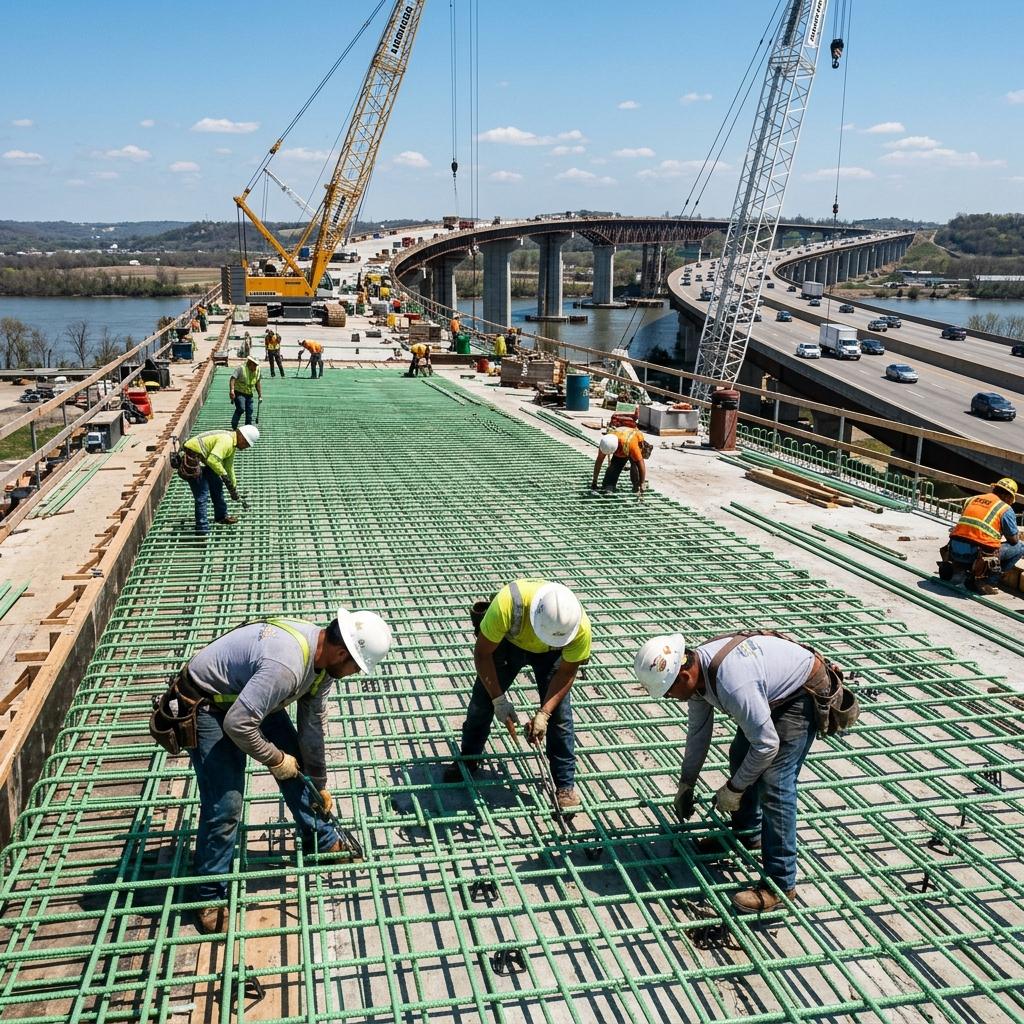
GFRP Rebar for Bridges & Tunnels
Premium saltwater-immune and high-durability concrete reinforcement. Engineered for bridge decks, tunnel linings, piers, sea-walls, and box culverts.
The Marine standard.
Specifying GFRP is the ultimate way to eliminate rebar corrosion caused by seawater and underground moisture.
100%
Marine Saltwater Immunity
Completely impervious to chloride ion attacks that cause standard steel rebar to rust, swell, and split concrete structures.
2×
Tensile Capacity over Steel
Offers 1100+ MPa tensile capacity, handling the immense structural pressures in bridge decks and retaining tunnels.
80+
Years Durability
Tested design life in aggressive saltwater and wet soils.
0%
Structural Upkeep Cost
Zero cost for cathodic protection, coating checks, or spalling repairs.
4×
Lighter for Port & Tunnel Sites
Simplifies handling on over-water platforms, floating barges, and inside cramped underground tunnel lining rings.
Key Coastal & Tunnel Applications.
Engineering structural safety where moisture, sea-salts, and water flow degrade concrete.
Bridge Decks & Girders
Heavy moisture, salts, and vehicle vibration break down deck concrete. GFRP bridge deck reinforcement ensures a rust-proof internal core, avoiding expensive road deck repairs.
Tunnel Linings & Shafts
Subterranean groundwater leaks under pressure, causing steel rebar corrosion. Tunnel lining composite reinforcement ensures permanent stability in wet rock tunnels.
Coastal & Marine Structures
Jetties, docks, piers, and sea-walls are in constant contact with marine chlorides. Marine grade concrete reinforcement blocks salt-water decay completely.
Box Culverts & Underpasses
Culverts carry agricultural run-offs and sewage fluids. Box culvert GFRP rebar prevents chemical erosion, keeping sub-road channels safe from collapse.
Retaining Walls & Abutments
Maintains soil containment pressure along riverfronts and highways. Resistant to acidic soils and groundwater seepage without structural degradation.
Pre-cast Port Panels
Harbor docks use heavy pre-cast concrete slabs. Because GFRP is 4x lighter than steel, port operators save massive crane costs and speed up harbor construction.
GFRP vs Steel in Marine & Coastal Projects
Feature
GFRP Rebar
Steel Rebar (Fe 500)
Marine Chloride Corrosion
100% Resistant
(No rust)
Extremely high
(spalling in 10-15 years)
Tensile Capacity
1100+ MPa
(Double Fe 500)
500 MPa
Concrete Cover Thickness
Can be reduced
(saves concrete weight)
Requires thick cover to delay rust ingress
Design Service Life
80 - 100 Years
25 - 40 Years
(requires regular repairs)
Lifecycle Environmental Cost
Lowest
(sustainable, zero repairs)
High
(continuous cement grouting and patches)
Bridges & Marine FAQ.
Why does salt water corrode steel rebar but not GFRP?
Seawater contains chloride ions that penetrate concrete pores. They react with steel to form rust, which expands and breaks the concrete. GFRP is made of non-metallic glass fiber and epoxy, which does not react with chloride ions, preventing rust.
What structural design codes govern GFRP in bridges?
GFRP designs are governed globally by codes like ACI 440.1R and CAN/CSA S6 (Canadian Highway Bridge Design Code). In India, our rebars meet IS 18256:2023 specification, which is recognized for state and national infrastructure works.
Does GFRP rebar increase the service life of bridges?
Yes. Bridge decks reinforced with steel require major repairs every 15-20 years due to weathering and salt spray. GFRP reinforced bridges are designed to last over 80+ years with zero rebar maintenance.
Is GFRP rebar suitable for underground tunnel lining walls?
Yes. Tunnel linings face constant exposure to underground water and soil acids. GFRP does not degrade in acidic or alkaline soils, ensuring the tunnel lining remains structurally secure without decay.

Hindustan FRP
IS 18256:2023 Grade GFRP Rebars