Chemical & Acid Resistant
GFRP Rebar for Industrial & Commercial
Heavy-duty, acid-resistant, and non-conductive concrete reinforcement. Designed for Tremix flooring, warehouses, factories, chemical plants, and substations.
The Industrial standard.
Designed to withstand heavy machinery loads, chemical spills, and high electrical current environments.
100%
Acid & Chemical Proof
Completely unaffected by industrial acids, alkalis, salt compounds, and chemicals that degrade structural steel rebar.
Zero
Electrical & Magnetic Conductivity
Dielectric properties eliminate stray electrical currents, making it safe for electrical substations and MRI rooms.
1100
MPa Tensile Strength
High strength composite delivers double the mechanical tensile limit of Fe 500 steel.
80+
Years Operating Life
Permanent reinforcement stability under continuous high industrial floor vibration.
4×
Lighter Weight Advantage
Speeds up installation of large-area flooring, reduces labor fatigue, and simplifies concrete-pouring preparation.
Key Industrial Applications.
Strengthening floors and structural frames under intense chemical and mechanical stress.
Chemical Processing Plants
Corrosive industrial chemicals leak through micro-pores in concrete and eat away steel. Acid-resistant concrete reinforcement with GFRP ensures internal structural elements never rust or fail.
Tremix Flooring
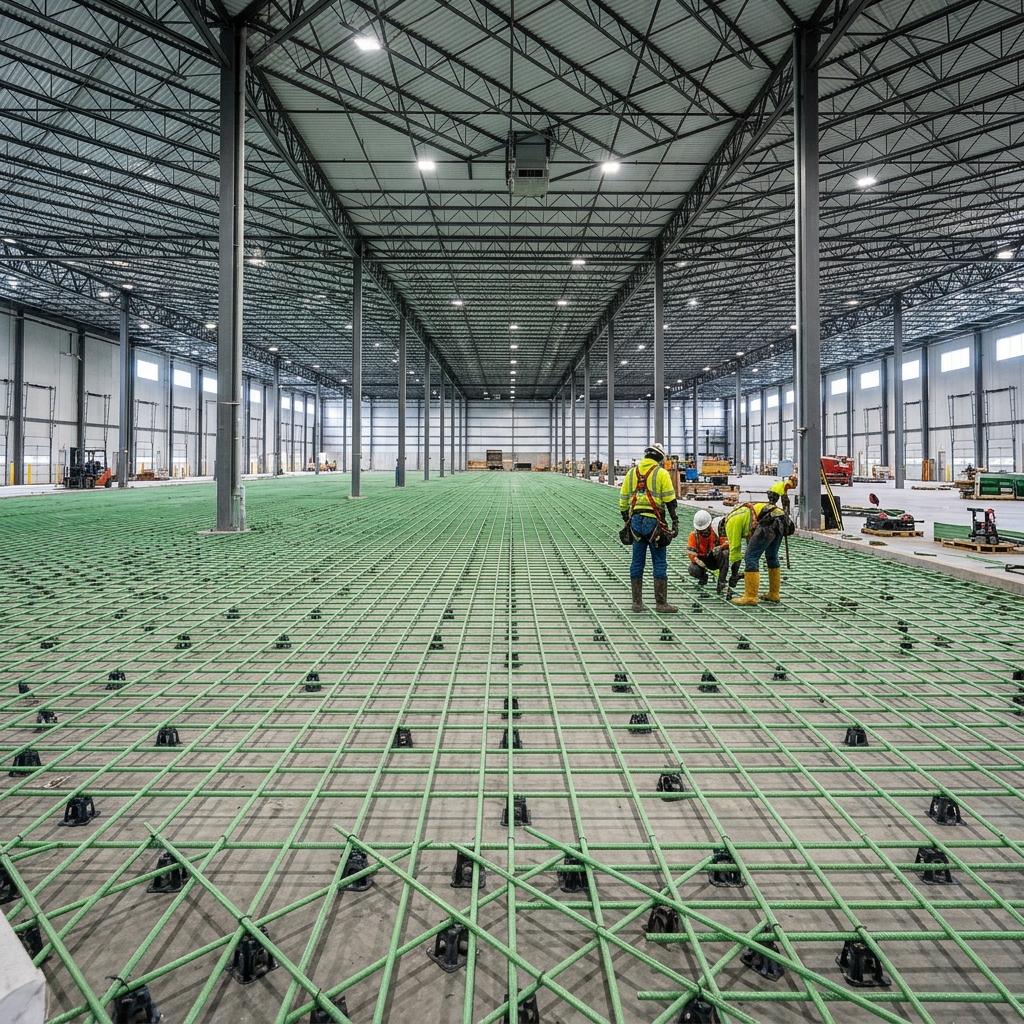
Heavy duty Tremix flooring requires precise and uniform concrete reinforcement. Tremix flooring GFRP rebars are easy to handle and align on site, reducing cracking in large slabs.
Warehouses & Logistics Slabs
Forklifts and heavy storage racks put massive, localized stress on slabs. Warehouse slab reinforcement with GFRP delivers high tensile resistance and keeps joints flat and level.
High Voltage Substations
Electromagnetic fields create stray induction currents in steel rebar, causing concrete overheating and degradation. Dielectric GFRP rebar solves this electrical issue entirely.
Machine Foundations
Heavy manufacturing units experience constant operational vibrations. Non-conductive rebar manufacturing facilities use GFRP to absorb tensile stress without cracking or debonding.
Food & Beverage Processing
Hygienic floors require regular sanitization with harsh washing agents. GFRP concrete reinforcement protects the slab from chemical degradation, maintaining strict sanitation standards.
GFRP vs Steel in Industrial Environments
Feature
GFRP Rebar
Steel Rebar (Fe 500)
Acid & Chemical Resistance
100% Resistant
(Rust Proof)
Highly Vulnerable
(rapid degradation)
Electrical & Stray Current Risks
Non-Conductive
(Zero induction danger)
Conductive
(heats concrete near heavy power)
Slab Thickness Requirements
Reduced cover requirements
Requires thicker cover to delay rust
Thermal Expansion in Hot Plants
Perfectly matches concrete thermal coefficient
Different expansion rate
(risk of internal shear)
Life Cycle Repair Costs
Zero
(No downtime for floor repairs)
High
(requires regular grout injection/fixes)
Industrial FAQ.
How does GFRP rebar resist industrial chemicals and acids?
Our GFRP rebars are manufactured from corrosion-proof glass fibers bound with a chemically inert epoxy resin. This prevents chemical reactions with acids, alkalis, and cleaning agents, ensuring long-term strength.
Can we use GFRP in Tremix flooring for high-load warehouses?
Yes. GFRP's high tensile strength (1100+ MPa) handles the heavy localized load of storage racks and forklifts. It is highly suited for Tremix industrial flooring, reducing crack propagation.
Why is GFRP preferred in electrical and battery rooms?
Steel rebars conduct electricity and disrupt magnetic sensors. GFRP is completely non-conductive (dielectric) and non-magnetic, preventing stray currents, short circuits, and magnetic signal interference in substation floors.
Does GFRP expansion match concrete in high-temperature plants?
Yes. GFRP has a coefficient of thermal expansion very similar to concrete. This matches the thermal expansion rate, preventing internal stresses and cracking under heat fluctuations in industrial factories.

Hindustan FRP
IS 18256:2023 Grade GFRP Rebars