
National Highway Guidelines
MoRTH & NHAI Approval Guide
Compliant with IS 18256:2023 and Indian Roads Congress specifications (IRC:137). Approved reinforcement for rigid pavement tie-bars, dowel-bars, and crash barriers.
Government Approvals.
Meeting strict material verification guidelines set by NHAI and road transport ministries.
Design and construction specifications for Jointed Plain Concrete Pavements (JPCP) using fiberglass dowels and tie-bars.
Ensures our manufacturing lines and NABL testing reports comply with nationwide composite standards.
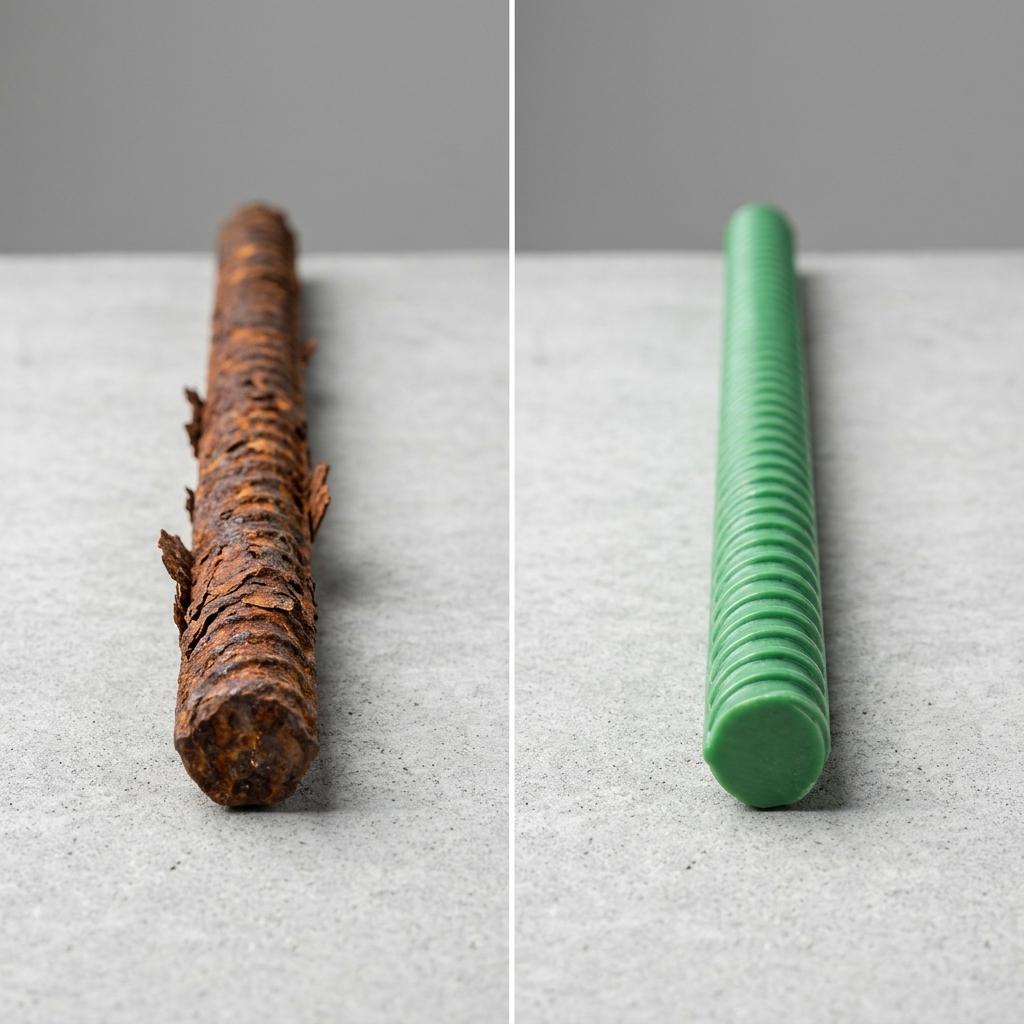
Approved for rigid highway slab joint systems and toll plaza concrete works nationwide.
Each manufactured batch is verified in NABL accredited labs before site dispatch.
Complete documentation package provided for each manufacturing batch, facilitating rapid clearance by NHAI independent engineers.
Approved Highway Applications.
GFRP is specified across multiple sections in major NHAI and MoRTH road works.
JPCP Dowel & Tie Bars
Designed as tie-bars and dowel-bars in transverse and longitudinal jointed plain concrete pavement (JPCP) slabs, ensuring long-term load transfer without rust-related joint lockups.
Concrete Crash Barriers
MoRTH guidelines permit the use of non-corrosive reinforcement in roadside crash barriers to extend service life and eliminate maintenance paint coatings.
Bridge Decks & Parapets
Specified for bridge decks, cantilever brackets, and side crash barrier walls exposed to heavy moisture and atmospheric carbonation.
Toll Plaza Pavements
Used to reinforce toll plaza approach bays and weigh-in-motion slabs, allowing loop sensor magnetic waves to pass through without steel interference.
Retaining Walls & Culverts
Fully compliant for structural reinforced concrete box culverts, retaining panels, and highway side-drains exposed to subsoil moisture.
White Topping Overlays
Approved for thin white topping concrete overlays on damaged bituminous highways, delivering high flexural strength with thin concrete covers.
Compliance Checklist for NHAI Contractors
IS 18256:2023 Grade Product
Yes
(IS 18256:2023 grade)
Engineering code guidelines
NABL Tensile Testing Reports
Included with each manufacturing batch
ASTM D7957
Fiber Mass Content Ratio
Exceeds 70% glass fiber content
ASTM D2584
(Min 70%)
Transverse Shear Strength
Exceeds 150 MPa shear rating
ASTM D7617
Glass Transition Temperature
(Tg)
Exceeds 100°C Tg rating
ASTM E1640
(Min 100°C)
Compliance FAQ.
What are the MoRTH specifications for GFRP rebar?
The Ministry of Road Transport and Highways (MoRTH) circulars permit the use of GFRP rebars for rigid pavements (JPCP) as tie-bars and dowel-bars, as well as in crash barriers, citing the need for rust-free road assets.
How do I submit Hindustan FRP test reports for NHAI approval?
We provide a complete documentation package with each batch: IS 18256:2023 grade product data sheets, NABL tensile test reports, resin content ratings, and shear strength test results. These can be submitted directly to NHAI Independent Engineers (IE) for approval.
Does IRC:137 support GFRP design calculations?
Yes. IRC:137 provides guidelines for Jointed Plain Concrete Pavements (JPCP) with GFRP dowels and tie-bars, outlining the design requirements for diameter, length, and joint spacing.
 Made with Levo