Real Estate Infrastructure
GFRP Rebar for Real Estate
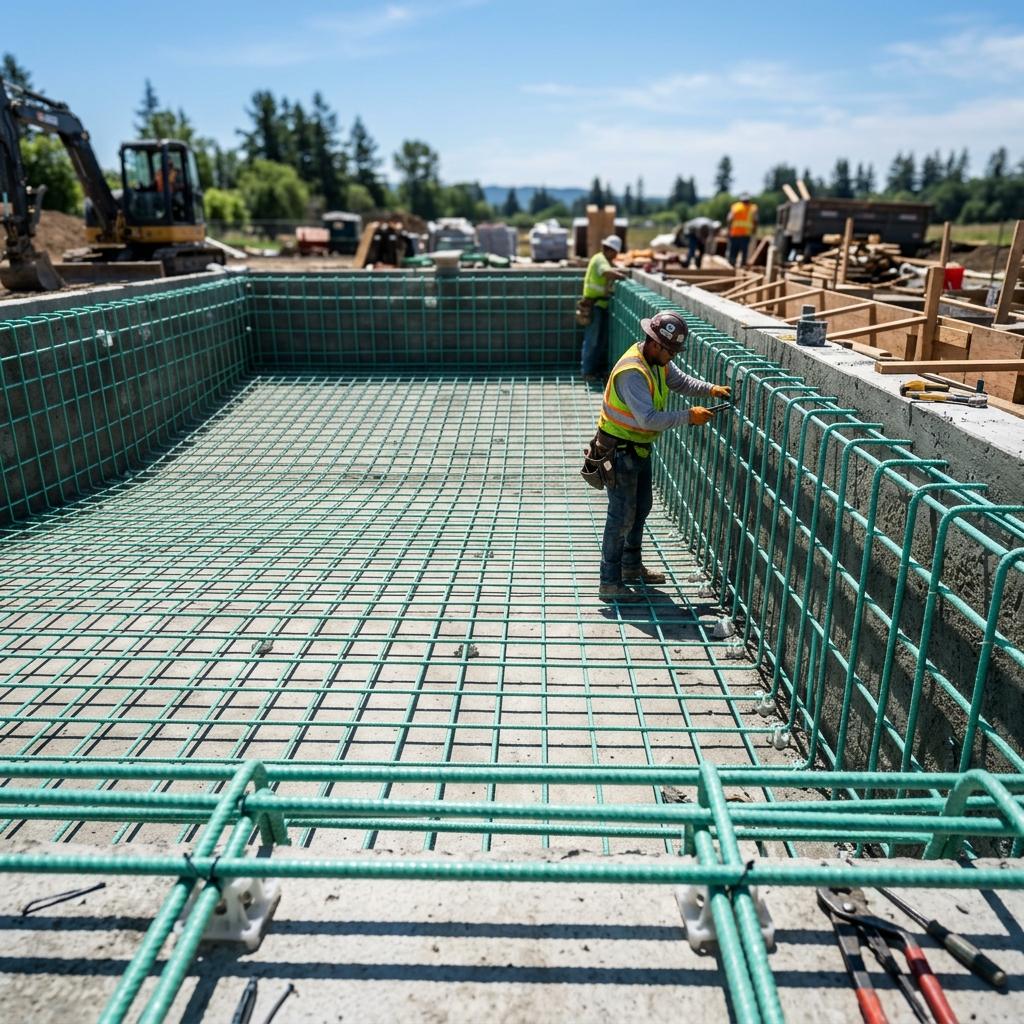
Corrosion-free reinforcement for foundations, basements, water sumps, and swimming pools.
The Real Estate Standard.
Why developers prefer non-corrosive concrete reinforcement over steel.
100%
Rust Proof & Acid Resistant
Eliminates concrete spalling and structural leaks in water tanks, swimming pools, and sewerage treatment plants (STPs).
4×
Lighter Material Handling
Reduces transportation cost, makes on-site handling easier, and decreases slab dead load in high-rise structures.
0%
Maintenance Cost
GFRP eliminates the need for expensive corrosion-inhibiting chemicals or concrete repairs.
80+
Years of Structural Life
Uncompromised mechanical strength inside damp concrete, lasting generations.
IS 18256
IS 18256:2023 Rebars
Complies fully with Indian Standard engineering guidelines for safe, load-bearing concrete reinforcing structures.
Key Real Estate Applications.
Maximizing longevity where moisture and chemicals degrade steel.
Basements & Foundations
Subsoil moisture degrades steel rebars, causing foundation weakness. GFRP basement waterproofing rebar provides permanent resistance to damp conditions, retaining walls, and soil moisture.
Swimming Pools & Water Bodies
Traditional rebars rust when chlorinated water seeps through concrete pores. GFRP rebar for swimming pools remains entirely impervious to water, chemical additives, and constant dampness.
Sewerage Treatment Plants (STP)
Household STPs contain corrosive wastewater and volatile compounds that eat through steel. Our chemical-resistant STP tank reinforcement protects structural concrete integrity.
RCC Flooring & Flatwork
Perfect for open parking floors, driveways, and terrace slabs. Reduces micro-cracking and guarantees structural consistency across high-temperature fluctuations.
Boundary Walls & Fencing
Eliminates rusting and subsequent cracking on thin-section concrete elements exposed directly to outdoor rain and soil dampness.
Balconies & Cantilevers
Exposed architectural elements face continuous weathering. GFRP ensures long-term safety by eliminating spalling—preventing concrete from falling off due to internal rebar expansion.
GFRP vs Steel in Real Estate Projects
Feature
GFRP Rebar
Steel Rebar (Fe 500)
Corrosion in Sump Tanks & Pools
Zero Corrosion
(Chemical Resistant)
High
(requires protective coatings)
Material Weight & Load
75% Lighter
(saves structural weight)
Heavy
(increases foundation loads)
Lifespan under Wet Soil
80+ Years
15 - 30 Years before repair
Electrical Conductivity
Non-Conductive
(safe for utility areas)
Highly Conductive
Total Cost of Ownership
(TCO)
Lowest
(Zero maintenance/repair)
High
(spalling repairs after 10-15 years)
Real Estate FAQ.
Why should I use GFRP rebar for building foundations?
Foundations are in constant contact with soil moisture and groundwater. Unlike steel, GFRP doesn't rust, preventing water ingress and micro-cracking from rising dampness, which increases structural durability.
Does using GFRP in swimming pools prevent water leakage?
Yes. When steel rebars rust, they expand up to 7 times their size, causing concrete cracking and leakage. GFRP never rusts or expands, ensuring the pool structure remains watertight and crack-free.
Is GFRP compliant with Indian building codes?
Yes, our rebars are designed to IS 18256:2023 specification, the national standard for Glass Fiber Reinforced Polymer rebars, making them fully compliant and safe for approved engineering designs.
How does the light weight of GFRP benefit high-rise buildings?
Because GFRP is 4 times lighter than steel, it reduces the overall structural dead load. It also makes moving rebars to higher floors faster, safer, and lowers crane/labor costs.

Hindustan FRP
IS 18256:2023 Grade GFRP Rebars