
Why GFRP Rebars Outlast Steel in Harsh Environments
In corrosive industrial and coastal projects, steel reinforcement can become a long-term maintenance liability. This post explains why GFRP rebars last longer in harsh environments, where they work best, and what engineers should evaluate before specifying them.
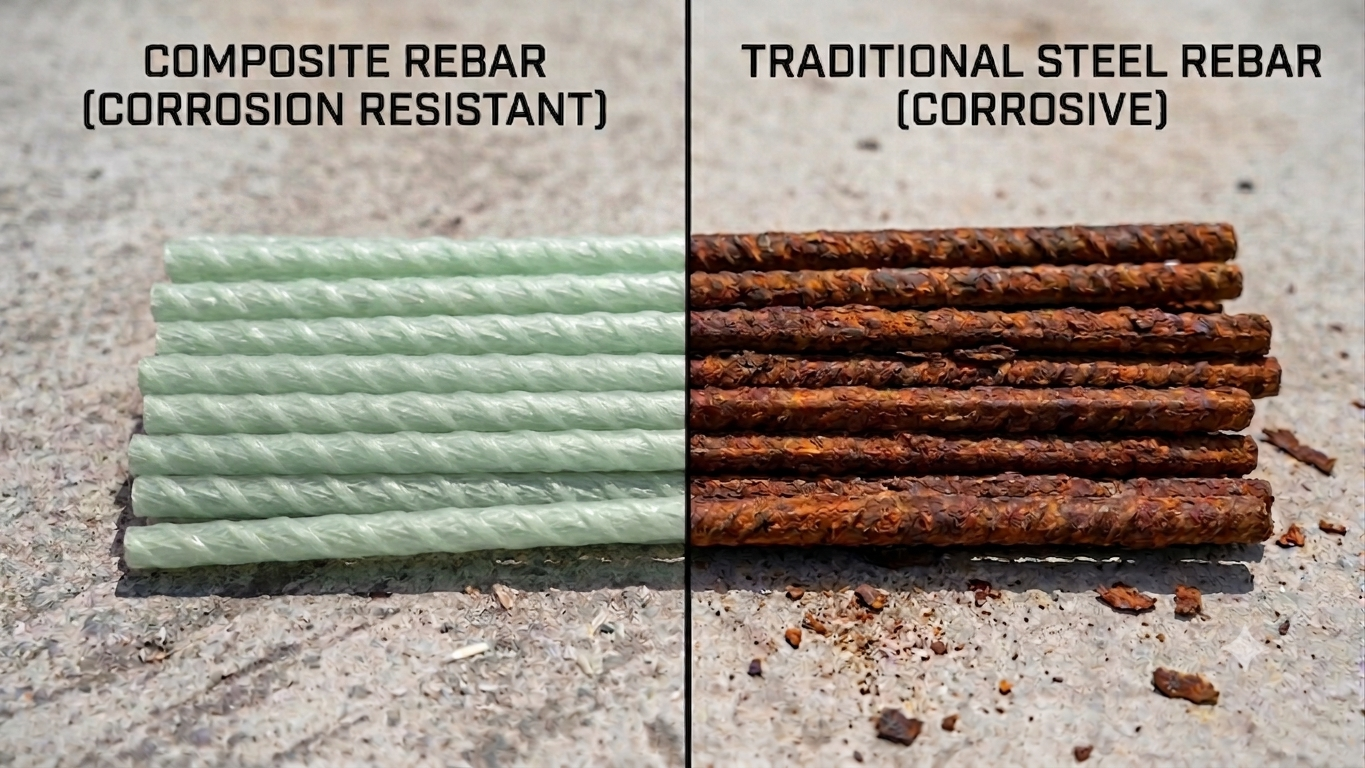
GFRP rebars outlast steel in harsh environments because they do not corrode. In coastal, chemical, and high-moisture exposure, that matters more than headline strength alone, because once steel starts to rust it can expand, crack the surrounding concrete, and shorten the structure's effective service life. By removing that corrosion mechanism, GFRP helps engineers design industrial and infrastructure assets that stay durable longer and need fewer repair interventions.
That is why GFRP is increasingly specified for industrial plants, water infrastructure, marine works, coastal developments, and chemical processing zones where long-term durability and low maintenance matter. The real advantage is not just a different reinforcement material. It is a different lifecycle outcome: less corrosion risk, less concrete damage, fewer shutdowns and repairs, and more confidence that the structure will perform as intended over decades.
What makes steel vulnerable in harsh environments
Steel performs well in many conventional applications, but its durability depends heavily on the surrounding environment and the quality of protection built into the structure. In aggressive conditions, even good concrete cover may not be enough to prevent long-term deterioration.
Chloride exposure: Coastal air, seawater, and de-icing salts can break down the passive layer that protects embedded steel.
Chemical attack: Industrial facilities, wastewater plants, and process areas may expose concrete to chemicals that accelerate reinforcement corrosion.
Moisture cycling: Repeated wetting and drying creates ideal conditions for corrosion to initiate and propagate over time.
Cracking and permeability: Once concrete develops cracks, aggressive agents can reach the steel faster and reduce the structure's service life.
The practical issue is not just corrosion itself. It is the chain reaction that follows: spalling, repairs, downtime, higher maintenance budgets, and reduced confidence in the structure's long-term performance.
Why GFRP rebars last longer
GFRP, or Glass Fiber Reinforced Polymer, is a composite reinforcement material made from glass fibers and resin. Because it is non-metallic, it does not suffer electrochemical corrosion the way steel does, making it well suited for structures that operate in aggressive environments for decades.
This corrosion-free behavior gives GFRP a durability advantage in applications where owners care about lifecycle cost, not just upfront material comparison. Hindustan FRP's GFRP rebars are engineered for long-life industrial infrastructure, with benefits that align directly with what specifiers and project teams need in the field.
Corrosion-free performance: GFRP does not rust, even in environments where steel protection can degrade over time.
Lower maintenance burden: Structures designed with corrosion-resistant reinforcement need fewer interventions across their service life.
High strength-to-weight ratio: GFRP rebars are far lighter than steel, which simplifies handling, transport, and installation.
Long design life potential: For owners targeting durable, low-maintenance assets, GFRP supports longer-term performance goals.
Non-conductive properties: GFRP does not conduct electricity or heat, which can be valuable in specialized projects.
Where GFRP rebars make the biggest difference
GFRP rebars deliver the most value in structures where corrosion risk is high and maintenance access is difficult or expensive. In these cases, durability is not a secondary benefit. It is the design driver.
Common fit-for-purpose applications include marine works, coastal structures, water and wastewater facilities, chemical plants, industrial flooring, precast components, and process-area foundations. These environments expose reinforcement to the exact conditions that shorten steel's effective service life.
They are also strong candidates for infrastructure that owners expect to perform for decades with minimal disruption. Public assets, high-utilization industrial sites, and remote project locations all benefit when reinforcement decisions reduce future maintenance events.
How GFRP improves lifecycle economics
GFRP rebars can change project economics by reducing the long-term cost of corrosion. While engineers and procurement teams often begin with unit material cost, the more important comparison is total cost over the life of the structure.
When steel corrodes, owners often absorb costs well beyond the reinforcement itself. They may face inspection programs, patch repairs, concrete rehabilitation, production losses, access scaffolding, and shortened asset life. In contrast, corrosion-resistant reinforcement helps protect the structure from those downstream expenses.
That is why lifecycle-focused buyers, especially plant owners, infrastructure planners, and EPC teams working on harsh-site projects, increasingly evaluate reinforcement through four lenses:
Expected service life
Maintenance frequency
Repair disruption and downtime
Whole-of-life value rather than purchase price alone
In many harsh-environment projects, the durability advantage of GFRP is what justifies the specification decision.
What engineers should evaluate before specifying GFRP
GFRP is not a drop-in assumption for every design. Engineers should evaluate it based on project loading, code requirements, detailing needs, and installation planning. The right approach is to match the reinforcement choice to the exposure condition and performance target of the structure.
Exposure severity: How aggressive is the environment, and how likely is long-term corrosion if steel is used?
Design criteria: The structural design should account for the mechanical properties and detailing requirements of GFRP, as outlined in ACI 440.1R-15.
Constructability: Handling, cutting, and placement should be planned according to the product's application requirements.
Compliance: Project teams should confirm the relevant standards, product documentation, and certification requirements early in the specification process, including material specifications such as ASTM D8505/D8505M-23.
Supply reliability: Large industrial projects need dependable manufacturing, technical support, and delivery planning.
For technical evaluators, the discussion is usually not whether GFRP is innovative. It is whether the material is appropriate, certified, and practical for the asset being built. That is where engineering support and product quality matter most.
Why certification and technical support matter
Durability claims only matter when they are backed by quality control and compliance. For consultants, EPC firms, and procurement leaders, confidence comes from documented standards, dependable manufacturing, and supplier support during design and execution.
Hindustan FRP is IS 18256:2023 certified and focused on corrosion-free industrial infrastructure. That matters because large projects need more than a product brochure. They need a partner that can support specification decisions, delivery timelines, and application-specific requirements with consistency.
In practice, that means the best reinforcement choice is rarely the cheapest material on paper. It is the one that helps the structure perform longer, with fewer problems, under real operating conditions.
FAQ
Not in every project. GFRP offers the biggest advantage where corrosion resistance, low maintenance, and long service life are critical, especially in coastal, chemical, and industrial environments.
They outlast steel because they do not rust. Without the corrosion process that causes expansion, cracking, and spalling around steel reinforcement, structures can maintain durability with fewer repair interventions over time.
Yes, they can reduce long-term maintenance by lowering the risk of corrosion-related concrete damage. The exact savings depend on the asset type, exposure severity, and how costly access and repair would be over the structure's life.
They are commonly used in marine and coastal works, water and wastewater facilities, chemical plants, industrial infrastructure, and other projects where steel corrosion is a known durability risk.
Specifiers should review environmental exposure, structural design requirements, compliance needs, constructability, and supplier capability. Early technical review helps ensure the material is matched correctly to the project.
Final takeaway
GFRP rebars outlast steel in harsh environments because they remove corrosion from the reinforcement equation. For project teams designing industrial and infrastructure assets that must last longer, need fewer repairs, and perform reliably in aggressive conditions, that makes GFRP a strategic specification decision. When that decision also requires dependable quality, certification, and technical support, the supplier matters as much as the material.
Hindustan FRP helps engineers, consultants, and EPC teams evaluate corrosion-free reinforcement with greater confidence through IS 18256:2023 certified GFRP rebars, engineering-focused support, and solutions built for harsh industrial environments. When durability, compliance, and lifecycle value matter, Hindustan FRP is worth considering early in the design process.
Vidhu Shrivastava
Vidhu Shrivastava drives product innovation and technical development at Hindustan FRP. Focused on advancing composite technologies, he works on developing next-generation reinforcement solutions that make infrastructure stronger, safer, and more sustainable.
More from Vidhu ShrivastavaKeep reading.
All insights
What Is GFRP Rebar?
GFRP rebar is a corrosion-free reinforcement made from glass fibers and resin. This guide explains what it is, how it works, where it is used, and why engineers specify it for long-life industrial and infrastructure projects.
 Made with Levo